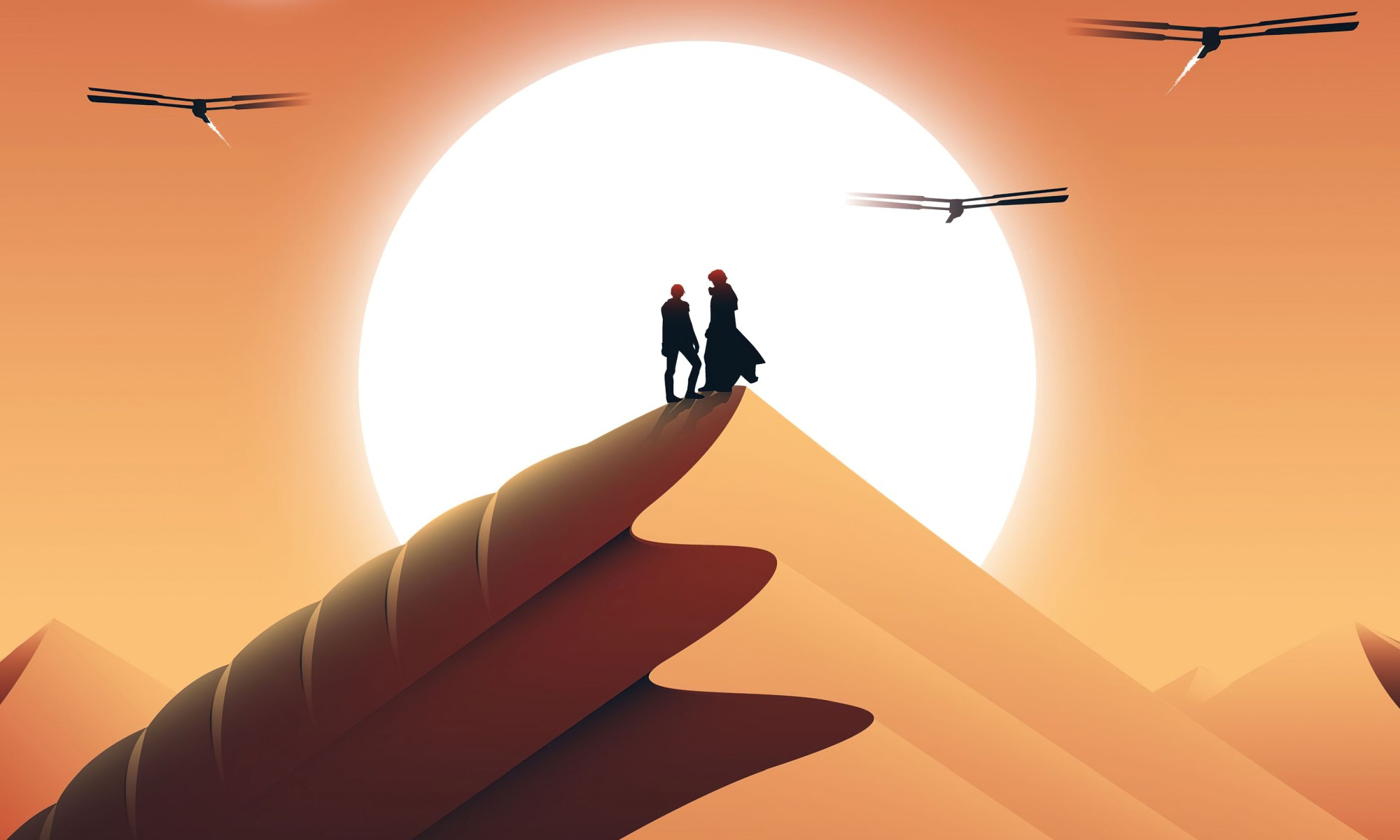


In the deep desert of Arrakis, beneath a sky trembling with heat, Muad’Dib stood before the gathered tribes.
The wind moved across the dunes like a whisper from Shai-Hulud. The Fremen waited.
Muad’Dib — Paul Atreides — lifted his hand.
“I will not ask you to die for a banner,” he said. “Nor for revenge. I will fight a different battle — not with crysknife, but with words.”
He spoke of a distant council chamber beyond the sands — the assembly of nations on old Earth.
“The true battlefield,” he said, “is not only the desert. It is the halls of power, where men decide the fate of rivers.”
He named ancient rivers — the Euphrates, the Tigris — waters once called the cradle of civilization. He spoke of Iraq, once Babylon, scarred by war and ambition.
“There were promises,” Muad’Dib said carefully. “Promises that armies would not linger forever. That lands would not be broken and left dry.”
He did not curse any leader by name. But the Fremen understood he spoke of powers like those once led by George W. Bush, whose war reshaped the region.
Muad’Dib raised his voice.
“I will go to the council of nations — to the great chamber known as the United Nations — and I will win hearts and minds. Not through fear. Through vision.”
He described a future beyond oil wars and border disputes.
“The Euphrates will flow free,” he said. “Date palms will grow again. The seeds you carry in your pouches will root in green soil.”
The Fremen murmured.
“Water,” Muad’Dib continued, “is power. We will not seize it — we will create it.”
He spoke of solar-powered desalination along forgotten coasts. Of gravity-fed channels carrying fresh water inland. Of greening deserts — not only Arrakis, but the Sahara and the lands between the rivers.
Some whispered: Is this not the Golden Path?
Muad’Dib’s gaze hardened.
“There will be no empire built on supremacy,” he said. “No greater dominion imposed by sword or prophecy. The future belongs to those who cultivate, not conquer.”
A young Fremen asked, “And if they refuse?”
Muad’Dib answered:
“Then we outgrow them. We show the world that paradise can be engineered without annihilation.”
Above them, the twin moons rose.
The jihad that once burned across the stars had taught him a terrible lesson: force wins territory, but vision wins time.
“And this time,” Muad’Dib said softly, “we fight to make the desert bloom.”
The Fremen struck their stillsuits in solemn rhythm.
Not for war.
For water.
